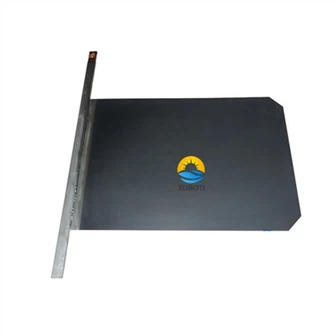
Why is titanium mostly used a cathode substrate during electrodeposition?
Electrodeposition, also known as electroplating, is a process in which a solution of metal ions in an electrolyte is electrochemically reduced to a conductive substrate, forming a thin metallic coating on its surface. The cathode is the electrode where the reduction takes place, while the anode is the electrode where the oxidation takes place. The substrate is the material on which the metal coating is deposited. The choice of substrate material for electrodeposition is important because it can affect the performance of the finished part or component.

Titanium material has good corrosion resistance and high strength. In practical application, the titanium plate has been immersed in electrolyte for more than 3000 working days in 9 years and collided with various operations for more than 20,000 times, but it is still intact, straight and smooth, and according to preliminary estimation, the service life can reach 20 years. The rate of the starting electrode sheet is greatly improved, from 75-80% to more than 98%. The use of titanium is a large investment, 3-4 times that of copper, but the total input cost for 9 years is only 21.68% of that of copper.
Reasons for using titanium cathode plate.
①The service life of titanium cathode plate is more than 3 times that of copper cathode plate, and it can be 10-20 years depending on the operating conditions.
②The oxide film on the surface of titanium cathode plate is equivalent to a good long-lasting and wear-resistant starting separator, which saves the separator and eliminates the pre-treatment process of the seed plate and makes it easy to peel off the starting plate. It is half lighter than copper cathode plate, thus greatly reducing labor intensity and increasing cathode stripping labor productivity by 25%~30%.
③Good electrode reaction stability. Titanium cathode plate metal itself reacts slowly and has good chemical stability, so it is not easy to be corroded by oxidizer and reducing agent. In the process of electrodeposition, the surface of titanium cathode plate will not be affected by the violent oxidation and reduction reaction. At the same time, the surface of titanium cathode plate has high flatness and better control of electrode reaction.
④The crystalline organization of the produced electrolytic copper is dense and ductile, and the surface is flat and smooth with excellent quality
⑤Since the titanium cathode plate does not need to be coated with separator, the contamination of copper electrolyte can be avoided.
⑥It can reduce the number of open cathode plate baths and increase copper production. After use, the yield of the starting sheet is greatly improved (>98%) because the starting sheet is easy to be peeled off and is not affected by the concentration and temperature of the separator. In this way, the number of open cathode plate slots can be reduced to meet the number of starting pieces required for production. The reduced number of cathode plate slots can be used for copper production, which can increase copper output, improve equipment utilization and reduce copper production cost.
⑦Easy to implement mechanization and automation

In conclusion, the use of titanium cathode plates has many advantages, including high chemical stability, low electrode reactivity, good electrode reaction stability and long life. These advantages make titanium cathode plates one of the preferred electrode materials for the preparation of metal thin films, alloy thin films and metal oxide thin films, etc.
For more information contact sales@xuboti.com