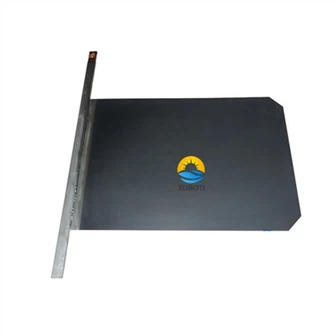
What is the Application of Dimensionally Stable Anode in Wastewater Treatment (DSA)
DSA (dimensionally stable anode) is another name for coated titanium electrode. This electrode is the primary form of metallic oxide. This is because the distance between cathode and anode does not change. The electrode wear and size are therefore stable. The electrolysis industry has used this dimensionally stable adode for many years because it is a great asset.

DSA is an electro-catalytic type of electrode that doesn't lack graphite or platinum. It also has a large supply of lead alloy and pbo2 as well. Comparing graphite electrodes and lead alloy electrodes, the DSA's interelectrode spacing doesn't change when electrolyzing. This can be used to ensure that the cell voltage remains stable during electrolysis. Due to its low voltage, DC consumption can be reduced by 10-20%. The use of Titanium Anode that has a long service life, and is corrosion resistant, can help solve the problem of lead and graphite dissolution, preventing the contamination of electrolyte.
DSA has developed a mature technology for electrochemical reactions as an anode that is insoluble. The insoluble anode has been widely used in the chlor-alkali industries. Electrolysis of salt liquor can be used to make caustic and chlorine. The main reaction of the positive polarity is chlorine evolution, while the secondary reaction, oxygen evolution, is at the negative pole. DSA can reduce the potential for chlorine evolution and allow bubbles to deviate easily.
DSA is widely used for electrolysis. DSA, as anode and insoluble anode, plays the roles of location and base during electrolysis. For example, separating oxygen from the PbAg anode. The Pb-Ag adode is used as an electro-catalyst for the charge transfer reaction, but it does not increase the electrode reaction. Base martial is used to cover noble metal catalytic oxides. Electrocatalysis with noble metal oxides has a large influence on the electric field at the electrode interface. As the electrode reaction progresses, the overpotential can increase in 10 to 5 orders of magnitude.
What is the use of dimensionally-stable anode in wastewater treatment?
In recent years, DSA has become the most widely used electrolysis process for high-concentration, refractory salt wastewater. In order to treat wastewater, electrochemical oxidation is used. This technology can alter the structure and nature of organic pollutants. This is an important field for the development of environmental protection because of its easy management, stable output water quality, decolorization effects, low land usage, and strong biodegradability.

DSA Lead Dioxide-coated Titanium Anode is used widely in electroplating and electrolysis. In electrochemical reactions the electrode plays a key role. It has a significant impact on reaction speed and mechanism. The electrode material also has a significant impact on many parameters such as the momentum point of an electrochemical reaction. Dimensionally stable anode, with their long life and lack of secondary pollution, are a good alternative to anode plates, which have a large volume and weight. Other properties include a simple process for many shapes, better catalytic properties and the ability to reuse substrate material. DSA is a versatile material that has many applications in electrochemical reactions.